Loading...

Experian’s new data marketplace enhances addressability across CTV, display, and mobile

Published: January 6, 2025 by Experian Marketing Services

At A Glance

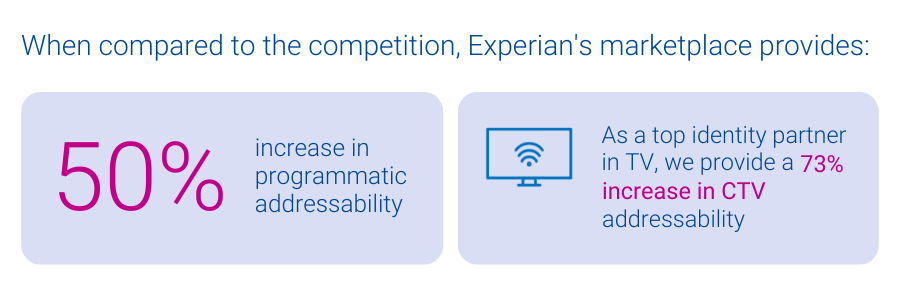
Experian has launched a new data marketplace that brings identity, interoperability, and addressability into one activation-ready platform. Built on verified offline and digital identity, it supports consistent audience activation across CTV, display, and mobile. Marketers and platforms gain broader reach and strong match rates.

As marketers face growing signal fragmentation, Experian has launched a data marketplace that brings addressability, interoperability, and identity resolution into one activation-ready platform.

Download the overview to see how our data marketplace connects high-quality identity to scalable activation across all screens.

Why does cross-channel audience consistency matter?

Marketers plan campaigns to reach people wherever they watch, browse, and engage. Consistent identity allows those plans to carry across screens without fragmentation.

Experian’s data marketplace starts with identity. Our data marketplace is built on our best-in-class identity graph which includes 126 million U.S. households, 250 million individuals, and more than four billion active digital IDs. This foundation supports reliable audience connections across channels and devices.

What distinguishes Experian’s data marketplace?

Experian connects the entire ecosystem — TV operators, programmers, supply-side platforms (SSPs), demand-side platforms (DSPs), and brands — with activation-ready audiences that drive measurable performance. Buyers can access data from retail, CPG, healthcare, B2B, location intelligence, and more.

Our audiences are built on verified offline data, which means they’re grounded in real-world accuracy, not just digital assumptions. When you activate through our marketplace, you:

  • Reach relevant audiences across screens
  • Maintain accuracy at scale
  • Support addressability as media environments evolve

Whether you’re running a campaign on connected TV (CTV), mobile, or display, we help you show up in the right place, to the right person, at the right time.

Related reading
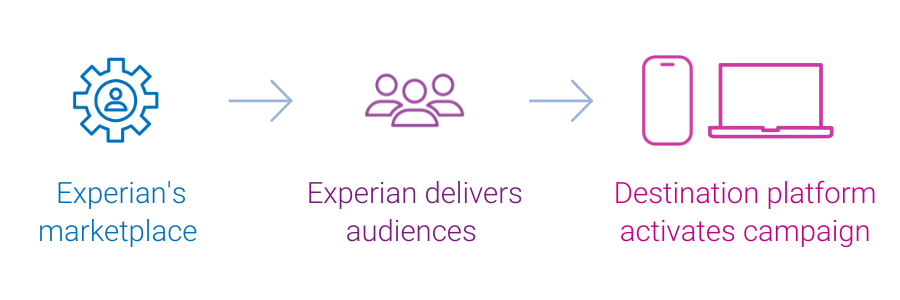
Experian marketplace -> Experian delivers audiences -> Destination platform activates campaign

“Experian has been a longstanding partner of DISH Media, and we’re excited to be an early adopter of their marketplace which leverages the foundation of their identity solutions to ensure maximum cross-channel reach as we look to expand the breadth and depth of data we use for addressable TV.”

DISH MediaKemal Bokhari, Head of Data, Measurement & Analytics

Want a quick overview of Experian’s data marketplace?

Watch our video for a quick overview of how Experian’s data marketplace works.

How does Experian’s data marketplace support buyers, sellers, and platforms?

Our data marketplace streamlines how teams plan, distribute, and activate data. Buyers and sellers align workflows while maintaining scale and accountability. Here’s how it delivers:

Enhance addressability icon

Enhances addressability and match rates

All audiences delivered from our marketplace benefit from our best-in-class offline and digital identity graphs, which ensure addressability across all channels like display, mobile, and CTV. Unlike other data marketplaces, Experian ensures all identifiers associated with an audience have been active and are targetable, improving the accuracy of audience planning.  

TV icon

Simplifies audience planning and distribution for TV Operators

TV operators can build custom audiences matched directly to their subscriber footprint and distribute them across all advanced TV channels (data-driven linear, addressable, digital, and CTV) for maximum impact.

Finger pointing at an object icon

Reintroduces choice within the data marketplace ecosystem

With the departure of Oracle’s advertising business, the optionality for buyers and sellers to connect with third-party data has become increasingly limited. With Experian’s data marketplace, we’re excited to offer a new solution to the market that ensures data-driven targeting can continue to take place at scale.

Dollar sign icon

Reduces activation costs

Experian’s data marketplace offers transparent, pass-through pricing with no additional access fees, enabling partners to maximize their earnings while reducing costs.

Audiences icon

Expands audience diversity and scale

Platforms can access a broad range of audiences across top verticals from our partner audiences, which can be combined with 3,500+ Experian Audiences. This offers the flexibility, reach, and scale necessary to effectively execute advertising campaigns.

Which data partners participate in Experian’s data marketplace?

Our data marketplace includes premium data from partners such as Alliant, Attain, Circana, Dun & Bradstreet, and more. Buyers activate these audiences alongside Experian Audiences within one workflow.
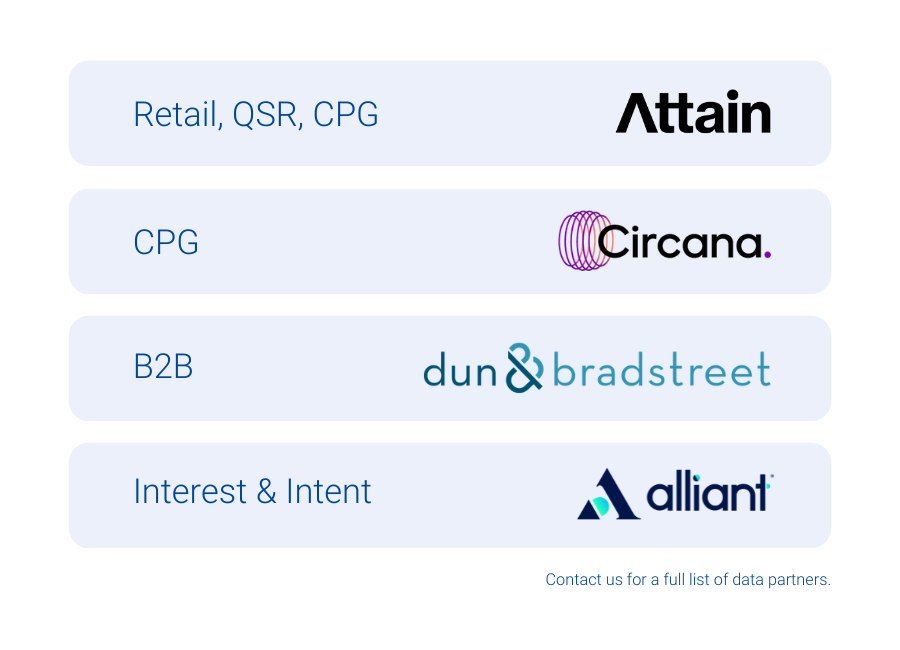
Experian marketplace partners

“Circana and Experian have enjoyed a deep partnership for over a decade. We are exceedingly excited to extend our partnership and be an early adopter and launch partner of the Experian data marketplace. This additional capability will enable the ecosystem to more easily access Circana’s purchase-based CPG and General Merchandise (for example Consumer Electronics, Toys, Beauty, Apparel etc.) audience segments to drive performance outcomes across all media channels.”

CircanaPatty Altman, President, Global Solutions

“Capturing the attention of target audiences across channels is critical for marketers navigating an increasingly connected digital world. We are excited to be an exclusive provider of B2B solutions within Experian’s marketplace, helping brands and media agencies to accelerate their reach, addressability and targeting capabilities across TV, mobile and connected TV channels.”

Dun & BradstreetGeorgina Bankier, VP of Platform Partnerships

How Yieldmo drove in-store traffic for an athletic retailer with Experian’s data marketplace

Yieldmo, a leading SSP known for its AI-powered creative formats and privacy-forward inventory, partnered with Experian to support an athletic retailer focused on in-store traffic during key sales periods. The team identified high-intent shoppers and activated them across channels.

Using our data marketplace, Yieldmo combined Experian Audiences with partner segments from Alliant, Circana, Webbula, and Sports Innovation Lab. This approach allowed the team to:

  • Identify in-store and conquest segments quickly
  • Combine first- and third-party audiencesin one place
  • Improve match rates and cross-channel addressability
  • Deliver measurable foot traffic lift
Alliant, Circana, Sports Innovation Lab, and Webbula logos

“Experian’s data marketplace fills a critical gap, letting us quickly search by brand, build smarter conquest segments, and activate audiences fast. The platform is flexible and the support is hands-on and reliable.”

YieldmoAbby Littlejohn, Director of Sales Planning

The campaign delivered faster setup, tailored audiences, and strong in-store performance with less manual effort.

Get started with Experian’s data marketplace

Experian’s data marketplace, easily accessible from our Audience Engine platform, brings unparalleled addressability, enabling our clients to reach more relevant consumers and increase revenue.

Talk to our team if you’re interested in learning more about our new data marketplace or becoming an active buyer or seller, or download our overview to learn more.

This site is protected by reCAPTCHA and the Google Privacy Policy and Terms of Service apply.


FAQs

What is Experian’s data marketplace?

Experian’s data marketplace is a centralized, activation-ready platform that allows TV operators, programmers, supply partners, and demand platforms to access and activate high-quality, privacy-compliant audiences across CTV, mobile, and display. It supports both first-party onboarding and third-party audience activation. 

Who is the Experian data marketplace designed for?

The Experian data marketplace is built for TV operators, programmers, supply partners, and demand platforms looking to improve audience targeting, match rates, and addressability across fragmented digital environments.

What types of audiences are available in the Experian data marketplace? 

The Experian data marketplace offers a mix of Experian proprietary audiences and third-party data partner segments across verticals like retail, CPG, B2B, healthcare, financial services, and location intelligence. Users can activate over 3,500 Experian Audiences and premium partner segments from providers like Alliant, Attain, Circana, Dun & Bradstreet, Webbula, and more. 

How does Experian ensure addressability and match rate performance? 

Experian’s data marketplace is powered by our identity graphs which are rooted in verified offline data, spanning 126 million U.S. households, 250 million individuals, and over four billion active digital identifiers. This foundation ensures that audiences are accurate, actively targetable, and optimized for high match rates across CTV, mobile, and display platforms.

Is Experian’s data marketplace privacy-compliant? 

Yes. All data in the Experian data marketplace is subject to Experian’s rigorous partner review process to ensure compliance with federal, state, and local consumer privacy regulations. Privacy and data stewardship are foundational to our data marketplace’s design.

What makes Experian’s data marketplace different from other data marketplaces? 

Experian’s data marketplace stands out for its focus on audience accuracy, partner integration, privacy compliance, and deep identity expertise. Here’s how we’re different: 
– Accurate audience planning: Unlike many other marketplaces, Experian ensures that all identifiers tied to an audience are verified as active and targetable — improving match rates and reducing waste. 
– Seamless partner audience integration: In one platform, you can activate Experian Audiences alongside premium segments from our growing partner network — including Alliant, Attain, Circana, and more. 
– Privacy and compliance built in: Every partner and audience goes through Experian’s rigorous review process to meet federal, state, and local consumer privacy laws — so you can activate with confidence. 
– Trusted identity foundation: Experian’s identity graph is grounded in decades of offline data expertise, powering more reliable targeting and activation than marketplaces built solely on digital signals. 
 

Where can I learn more or get started? 

You can download the overview to explore the capabilities, or contact our team to become an active buyer or seller. The Experian data marketplace is available through Experian’s Audience Engine platform. 


Latest posts

Loading…
What happens when first-party, third-party, contextual, and geographic data work together

How should CMOs think about data as part of their audience strategy? The best digital marketers possess excellent storytelling capabilities—and they fuel the plot with data. When you think about it, your audience strategy is the whole story, and the type of data you use helps create each chapter. Just as any good book incorporates numerous literary devices, you must use more than one type of data to develop a dynamic, relevant, and timely narrative that captures your target users’ attention. In 2026, marketers should prioritize and invest in data and targeting strategies beyond just first-party to drive growth, improve efficiency, and strengthen customer relationships. Our 2026 Digital trends and predictions report is available now and reveals five trends that will define 2026. From curation becoming the standard in programmatic to AI moving from hype to implementation, each trend reflects a shift toward more connected, data-driven marketing. The interplay between them will define how marketers will lead in 2026. Download Why is first-party data not sufficient on its own? First-party data provides a strong foundation for targeting and measurement. It reflects information consumers have shared directly through brand interactions. That makes it reliable and central to audience strategy. That foundation alone does not tell the full story. First-party data defines known customers, but limits reach and frequency. Growth depends on expanding beyond existing relationships. Think of first-party data as a way to create an outline, not the whole story, about your target audiences—the main characters in your marketing. To flesh out the entire narrative about them, you must source, connect, and activate additional data. The ability to unify different data sources with accuracy, scale, and privacy at the forefront sits at the core of Experian’s business. We unify household, individual, device, demographic, behavioral, and first-party signals, along with contextual and geographic data points, to build a reliable view of consumers, even when specific signals are missing. This clarity helps you personalize, target, activate, and measure with confidence. By layering third-party data, contextual data, and geolocation data onto your first-party data foundation, your advertising strategies become stronger than if you used any of these sources as standalone solutions. How do different types of third-party data add depth to audience profiles? Third-party data expands understanding beyond known customers. If first-party data is the outline, third-party data helps with “character development”—a.k.a., adding detail to your audience profiles. Good third-party marketing data complements first-party insights with demographic, behavioral, and transactional context, providing the missing puzzle pieces to complete the full customer profile. Filling in gaps in customer understanding helps you identify, reach, and engage current and new customers more effectively. Third-party data allows brands to build loyalty with consumers by speaking to their interests and intent behind purchases. Third-party data opens up new targeting tactics for advertisers, such as: Behavioral How people engage with brands or how they use social media Demographic Age, gender, education, income, and religion Health A combination of demographics, behaviors, and health needs Interest Delivering ads based on interests, hobbies, or online activities Location Where people live, work, or spend large amounts of time Psychographics Shared characteristics like attitudes, lifestyles, and interests Purchases Using previous purchase behavior to identify the right audiences In addition to targeting, third-party data also remains critical to AI models, which must train on both structured and unstructured data. At Experian, our AI-powered technology interprets live bidstream data, device activity, content, and timing to optimize in the moment, ensuring campaigns deliver meaningful relevance, not just broader reach. How are contextual and geographic approaches reshaping audience targeting? Contextual and geographic approaches to targeting focus on environment and behavior rather than identifiers. Regulatory scrutiny, stricter and more fragmented compliance standards, and rising consumer expectations are transforming how marketers approach third-party data targeting. Evolving privacy laws and inconsistent identifiers across environments require new approaches that balance performance and privacy. Contextual and geographic targeting help marketers reach relevant audiences while maintaining privacy. What is data-informed contextual targeting? Contextual targeting connects audience attributes to the content environments people choose. It helps determine the setting of your story—where your characters spend their time. Solutions like Experian’s Contextually-Indexed Audiences harness advanced machine learning technology to combine contextual signals (a tried–and-true targeting tactic) with third-party targeting to ensure marketers reach their target audiences on the content they tend to consume, regardless of environment or location. What’s excellent about data-informed contextual targeting is that it moves beyond traditional keyword-based strategies to reach consumers on websites that over-index for visitors with the demographics, behaviors, or interests they are looking to target. What is data-informed geotargeting? Geotargeting uses shared location patterns to support relevance at scale. Geotargeting is another possibility for further developing the scene of your story. People with similar behaviors and interests tend to live in similar areas, which is why so much effort goes into location planning for brick-and-mortar stores. Data-informed geotargeting combines geos with third-party data to make more informed media buys based on common behaviors within a geographic location. We launched our Geo-Indexed audiences, which use advanced indexing technology to identify and reach consumers based on their geographic attributes. These audiences help marketers discover, segment, and craft messaging for consumers without relying on sensitive personal information, enabling them to reach target audiences while maintaining data privacy confidently. What role does AI play in third-party data targeting? AI acts like an automated editor of your book, refining and finding new ways to put valuable third-party audiences and data to work without relying on segments linked to known or disparate identifiers. We’ve used AI and machine learning at Experian for decades to bring identity, insight, and generative intelligence together so brands and agencies can reach the right people, with relevance, respect, and simplicity. Why does a balanced, integrated approach that combines first-party, third-party, contextual, and geo-targeting data matter? The combined effects of integrating third-party, contextual, and geotargeting data (and the marketing tactics it underpins) with first-party data will drive your success. Think of how any good author crafts a story. Regardless of whether it’s fiction or non-fiction, they draw on both first-person experience and external research and sources to develop their plot. No single data source tells the full story. Integration allows marketers to understand audiences more completely and act with confidence. Pooling these inputs together moves you closer to your goal of understanding the whole story about your target customers. In fact, an almost even number of marketers plan to use contextual targeting (41%) and first-party data (40%) as their main targeting strategies, amid privacy laws and the loss of persistent advertisers. Primary data strategyPercent of marketers that plan to use this data strategyContextual targeting41%First-party data40% A brand with strong first-party insights can extend reach by layering in additional signals. For example, a nutrition brand that knows who purchases protein supplements can expand prospecting by combining: First-party signals Customers who purchase protein supplements Contextual signals Engagement with fitness blogs, healthy recipe content, or workout apps Geographic signals Consumers located in the Greater Philadelphia area By connecting these inputs, the brand can identify new health-conscious audiences with similar interests and behaviors. This approach supports privacy-safe targeting while improving engagement and performance. How can marketers build an integrated data strategy in 2026? An integrated data strategy reduces friction and supports scale. The right data partner offers a unified solution that helps unify data, activate audiences, and adapt as the ecosystem evolves. Here’s how: Organize data Create a clean, usable data foundation by eliminating fragmented silos. Experian’s solutions unify disparate data, enabling identity resolution and a single customer view. Create a complete profile Experian links a persistent offline core of personally identifiable information (PII) data with fresh digital signals, giving you a high-fidelity view of consumers to decorate with marketing data. This allows for improved customer understanding and personalized marketing that competitors struggle to replicate. Build addressable audience segments Create audiences using a mixture of signals, including first-party data, third-party behavioral, interest, and demographic data, as well as contextual signals. If you partner with Experian, you can use audiences built on our identity graph to guarantee accuracy, scale, and maximum addressability. Drive innovation Look for partners and platforms that prioritize innovation in finding new ways to reach target audiences across the ecosystem. You don’t want a vendor or a system that can’t keep pace and adapt with our rapidly evolving industry. Marketers who want to create and activate campaigns more efficiently and effectively in 2026 need an integrated approach that combines first-party, third-party, contextual, and geotargeting data. Streamlining data integration and activation positions brands and agencies for sustainable growth and stronger consumer relationships in a privacy-conscious marketplace. Build your next chapter on a connected data foundation As audience strategies evolve, connection and interoperability matter more than ever. Connect with our team to learn how Experian helps marketers unify data, identity, and activation across channels. About the author Scott Kozub VP, Product Management, Experian Scott Kozub is the Vice President of the Product Management team at Experian Marketing Services working across the entire product portfolio. He has over 20 years of product experience in the marketing and advertising space.  He’s been with a few startups and spent many years at FICO and Oracle Data Cloud heavily focused on loyalty marketing and advertising technology. FAQs How should CMOs think about data as part of their 2026 audience strategy? In 2026, CMOs should prioritize and invest in data and targeting strategies that combine first-party, third-party, contextual, and geographic data to drive growth, improve efficiency, and strengthen customer relationships.  Why is first-party data not sufficient on its own?  First-party data is not sufficient on its own because first-party data defines known customers but limits reach and frequency. Growth depends on expanding beyond existing relationships. The ability to unify different data sources with accuracy, scale, and privacy at the forefront sits at the core of Experian’s business. We unify household, individual, device, demographic, behavioral, and first-party signals, along with contextual and geographic data points, to build a reliable view of consumers, even when specific signals are missing. This clarity helps you personalize, target, activate, and measure with confidence. How do different types of third-party data add depth to audience profiles? Third-party data expands understanding beyond known customers. Third-party data opens up new targeting tactics for advertisers, such as:  – Location: Where people live, work, or spend large amounts of time- Health: A combination of demographics, behaviors, and health needs- Purchases: Using previous purchase behavior to identify the right audiences – Behavioral: How people engage with brands or how they use social media – Interest: Delivering ads based on interests, hobbies, or online activities- Psychographics: Shared characteristics like attitudes, lifestyles, and interests- Demographic: Age, gender, education, income, and religion  In addition to targeting, third-party data also remains critical to AI models, which must train on both structured and unstructured data. At Experian, our AI-powered technology interprets live bidstream data, device activity, content, and timing to optimize in the moment, ensuring campaigns deliver meaningful relevance, not just broader reach.  What is data-informed contextual targeting? Data-informed contextual targeting connects audience attributes to the content environments people choose. It helps determine the setting of your story—where your characters spend their time. Experian’s Contextually-Indexed Audiences harness advanced machine learning technology to combine contextual signals (a tried–and-true targeting tactic) with third-party targeting to ensure marketers reach their target audiences on the content they tend to consume, regardless of environment or location. What is data-informed geotargeting? Data-informed geotargeting uses shared location patterns to support relevance at scale. Experian launched our Geo-Indexed audiences, which use advanced indexing technology to identify and reach consumers based on their geographic attributes. These audiences help marketers discover, segment, and craft messaging for consumers without relying on sensitive personal information, enabling them to reach target audiences while maintaining data privacy confidently. What role does AI play in third-party data targeting? In third-party data targeting, AI refines and finds new ways to put valuable third-party audiences and data to work without relying on segments linked to known or disparate identifiers. We’ve used AI and machine learning at Experian for decades to bring identity, insight, and generative intelligence together so brands and agencies can reach the right people, with relevance, respect, and simplicity.  Latest posts

Jan 28,2026 by Scott Kozub, VP, Product Management

Why activation and measurement will finally connect in 2026

For years, marketers have worked around a familiar disconnect. Campaigns go live first. Measurement follows later. Insights arrive after audiences are reached, and budgets are committed. That gap has slowed decisions, blurred performance signals, and limited marketers’ ability to respond when it counts. In 2026, that model changes. Activation and measurement no longer operate as separate steps. They function as a single system, where insight informs action as campaigns unfold. Consistency across identity, data, and decision-making sits at the center of this shift, connecting the full campaign lifecycle from planning through outcomes. How is marketing measurement shifting from post-campaign reporting to in-flight intelligence in 2026? Marketing measurement in 2026 is moving from retrospective reporting to real-time input that shapes campaigns while they run. Instead of explaining performance after delivery, measurement now guides creative, audience, and channel decisions as verified outcomes appear. Historically, measurement worked like a post-mortem. Dashboards showed what happened after campaigns ended, or weeks after impressions were delivered. Those insights supported long-term planning but rarely influenced performance in the moment. That dynamic has changed. Today, marketers embed measurement directly into activation. Campaigns adapt while they run. Creative evolves based on engagement quality. Audience strategies adjust as verified outcomes come into view. Channel investments respond to performance signals, not assumptions. Connected ecosystems make this possible. Experian helps marketers plan, activate, and measure within a single framework by linking audiences, identity, and outcomes. When planning and performance live in the same environment, insight becomes actionable in the moment. Why is identity the connective layer between activation and measurement? Identity provides the consistent thread that links planning, activation, and outcomes into a unified system. Without it, marketers rely on proxy signals and disconnected views of performance. For years, fragmented identity frameworks made it difficult to connect media exposure to real-world outcomes. Without a consistent way to recognize audiences across planning, activation, and measurement, marketers relied on proxy metrics and modeled assumptions. That's changing as identity becomes interoperable across the ecosystem. Experian’s Digital and Offline Graphs help marketers onboard and resolve their data into a clean, connected foundation that supports everything that follows. From building audiences enriched with behavioral, demographic, and lifestyle insights, to activating those audiences across channels like connected TV (CTV), social, and programmatic through direct integrations with more than 200 platforms. When identity stays consistent from the first impression through final outcome, marketers gain a clearer view of what drives performance and where to act next. Our 2026 Digital trends and predictions report is available now and reveals five trends that will define 2026. From curation becoming the standard in programmatic to AI moving from hype to implementation, each trend reflects a shift toward more connected, data-driven marketing. The interplay between them will define how marketers will lead in 2026. Download How does closed-loop measurement become standard in 2026? Closed-loop measurement is becoming the default as activation and measurement come together. Marketers now tie exposure directly to verified business outcomes instead of relying on inferred signals. In partnership with MMGY Global, we helped Windstar Cruises connect digital impressions directly to bookings. The result was more than 6,500 verified bookings and $20 million in revenue tied back to campaign exposure. That translated to a 13:1 return on ad spend. Download the full case study here This level of accountability changes how marketers optimize. Instead of relying on clicks or inferred intent, teams can measure outcomes that reflect business impact. Store visits. Purchases. Site activity. These signals now guide decisions while campaigns are live. Through curated private marketplace deals and supply-path optimization, Experian also helps reduce cost, and improve reach and performance. With Experian and Audigent operating as one, marketers gain access to scalable, privacy-conscious data solutions that support both addressability and accountability across the supply chain. What should marketers plan for as activation and measurement connect in 2026? Marketing teams should prepare for an operating model built around continuous feedback, unified systems, and verified outcomes. This shift changes how success is defined and managed. Marketers should plan for: Always-on feedback loops Real-time signals guide creative, audience, and channel decisions while campaigns are in flight. Unified planning, activation, and outcome validation Integrated identity and audience frameworks allow marketers to trace value across every impression, not just the last click. Outcome-based performance signals Measurement will focus less on surface-level performance and more on true business impact, including sales, bookings, and long-term value. Greater use of first-party data Connected first-party data supports consistent activation and outcome validation across channels. Whether you're activating your own data or reaching new audiences, Experian connects every stage of the campaign. From early planners to last-minute buyers, we help you show up in the moments that matter and prove what is working. The takeaway Marketing's next chapter centers on connection. As data systems unify, activation and measurement operate as one. Insight flows directly into action. Decisions are guided by intelligence, not delayed reporting. With Experian, marketers plan, reach, and measure in a connected cycle. Every impression is measurable. Every audience is accurate. Every decision is powered by data ranked #1 in accuracy by Truthset. To explore this trend and the others shaping marketing in 2026, download our 2026 Digital trends and predictions report. Download Ready to connect with our team? About the author Ali Mack VP, AdTech Sales, Experian Ali Mack leads Experian’s AdTech business, overseeing global revenue across the company’s expansive tech and media portfolio. With over a decade of experience in digital and TV advertising, Ali drives strategic growth by aligning sales, customer success, and solutions teams to deliver impactful outcomes for clients and partners. She has successfully guided teams through two major acquisitions, integrating sales organizations and product portfolios into unified go-to-market strategies. Under her leadership, Experian has consistently exceeded revenue targets while fostering collaborative, results-driven teams and mentoring emerging leaders. Working closely with finance, product, and marketing, Ali develops strategies that support a diverse ecosystem of publishers, brands, and technology partners, positioning Experian at the forefront of data-driven advertising and identity resolution. FAQS How is marketing measurement shifting from post-campaign reporting to in-flight intelligence in 2026? Marketing measurement in 2026 is moving from retrospective reporting to real-time input that shapes campaigns while they run. Instead of explaining performance after delivery, measurement now guides creative, audience, and channel decisions as verified outcomes appear. Connected ecosystems make this possible. Experian helps marketers plan, activate, and measure within a single framework by linking audiences, identity, and outcomes. When planning and performance live in the same environment, insight becomes actionable in the moment. Why is identity the connective layer between activation and measurement? Identity provides the consistent thread that links planning, activation, and outcomes into a unified system. Without it, marketers rely on proxy signals and disconnected views of performance. Experian’s Digital and Offline Graphs help marketers onboard and resolve their data into a clean, connected foundation that supports everything that follows. From building audiences enriched with behavioral, demographic, and lifestyle insights, to activating those audiences across channels like connected TV (CTV), social, and programmatic through direct integrations with more than 200 platforms. How does closed-loop measurement become standard in 2026? Closed-loop measurement is becoming the default as activation and measurement come together. Marketers now tie exposure directly to verified business outcomes instead of relying on inferred signals. In partnership with MMGY Global, we helped Windstar Cruises connect digital impressions directly to bookings. The result was more than 6,500 verified bookings and $20 million in revenue tied back to campaign exposure. That translated to a 13:1 return on ad spend. What should marketers plan for as activation and measurement connect in 2026? Marketers should plan for: always-on feedback loops, unified planning, activation, and outcome validation, outcome-based performance signals, and greater use of first-party data. Whether you're activating your own data or reaching new audiences, Experian connects every stage of the campaign. From early planners to last-minute buyers, we help you show up in the moments that matter and prove what is working. Latest posts

Jan 27,2026 by Ali Mack, VP, AdTech Sales

Claritas audiences are now available in Experian’s data marketplace

Claritas, known for advanced consumer segmentation, is bringing its premium audiences into Experian Data Marketplace. PRIZM® Premier, P$YCLE® Premier, ConneXions® Premier and CultureCode® audiences are now available, giving marketers access to more than 1,700 syndicated segments in a frictionless, privacy-compliant way. Marketers can move from planning to activation faster, with lifestyle, and financial audiences built for modern media. The value of these insights is clear: richer, behavior-driven audience intelligence that supports more relevant targeting across connected TV (CTV), digital, and linear. How Claritas audiences are built Claritas audiences are built from more than 10,000 predictive behavioral indicators, robust survey linkages, and household-level demographic data. These inputs create deterministic, privacy-safe signals that go beyond broad demographic proxies and help reveal consumer intent. That detail matters in CTV and programmatic environments. Marketers can activate pre-modeled segments tied to automotive ownership, financial behaviors, telecom preferences, and brand affinities. Three ways Claritas audience support omnichannel activation High-fidelity signals for more effective targeting Claritas uses deterministic, behavior-based indicators to add context around lifestyle, purchase patterns, financial posture and technology behaviors. Each segment includes Living Unit ID (LUID) counts, CPM transparency, and match-rate details. Broad reach across channels Many segments include 30M–50M+ active LUIDs, supporting broad reach without sacrificing audience clarity. Activate these audiences in omnichannel campaigns across the destinations that matter most, including CTV, programmatic display/video, paid social, and email, enabled through integrations with major demand side platforms (DSPs) and activation platforms. Privacy-first design Claritas data is built from consented, privacy-safe inputs and does not rely on cookies or exposed personally identifiable information (PII). This approach supports cookieless media, including CTV. Where Experian adds lift to audience activation Experian's data marketplace and our identity and governance tools help operationalize Claritas segments for activation:  Enhanced addressability: Deterministic identity resolution maps Claritas signals to reachable, active audiences. It utilizes Experian identity graphs, which are rooted in verified data, spanning 126 million U.S. households, 250 million individuals, and over four billion active digital identifiers. Activation: Integrations with major DSPs and media platforms support fast deployment. Governance: Our controls support responsible data handling through the activation workflow, and ensure available audiences comply to all federal, state, and local consumer privacy regulations. Together, Claritas segmentation depth and our identity resolution support audience planning, activation, and measurement at scale. How marketers use Claritas audiences Automotive: Connect with owners and intentenders A luxury automotive brand can target “Cadillac owners” or “Likely Luxury Intenders” using Claritas behavioral automotive indicators. With more than 42 million available LUIDs for Cadillac owners, original equipment manufacturers (OEM) can support CTV campaigns, conquest strategies, and multicultural initiatives with more confidence. Financial services: Reach high-value households Using P$YCLE® Premier, a card issuer can target consumers who actively use travel reward cards or who fall into specific wealth tiers. These insights help tailor offers, personalize messaging, and reach consumers more likely to convert, supported by Claritas’ AI-driven optimization that can increase conversions by up to 30%. The advantage: Claritas depth plus Experian scale Claritas audiences in Experian’s data marketplace give marketers a direct path from insight to activation. Claritas brings behavioral intelligence and segmentation depth and we bring identity, scale, and governance. Together, you can plan, activate, and measure campaigns with stronger audience clarity from day one. Contact us to get started FAQs What are Claritas audiences in Experian’s data marketplace? Claritas audiences are syndicated consumer segments built from behavioral, lifestyle, financial, and demographic data. Through Experian’s data marketplace, marketers can activate more than 1,700 Claritas segments using privacy-compliant, deterministic signals. Where can marketers activate Claritas audiences? Marketers can activate Claritas audiences directly through Experian’s data marketplace across CTV, programmatic display, social, email, and linear. Integrations with major DSPs and Experian identity resolution support privacy-compliant activation at scale. How are Claritas audiences built? Claritas audiences are built from more than 10,000 predictive behavioral indicators, survey-based insights, and household-level demographics. How does Experian support Claritas audience activation? Experian supports activation through identity resolution, governance controls, and direct platform integrations. Claritas signals are mapped to reachable audiences using the Experian identity graph.  Latest posts

Jan 22,2026 by Experian Marketing Services


Subscribe to our newsletter

Enter your name and email for the latest updates

This site is protected by reCAPTCHA and the Google Privacy Policy and Terms of Service apply.

About Experian Marketing Services

At Experian Marketing Services, we use data and insights to help brands have more meaningful interactions with people. As leaders in the evolution of the advertising landscape, Experian Marketing Services can help you identify your customers and the right potential customers, uncover the most appropriate communication channels, develop messages that resonate, and measure the effectiveness of marketing activities and campaigns.

Visit our website

Subscribe to our newsletter

Stay up to date on the latest industry news and receive expert tips from our marketing experts.
Subscribe now!